
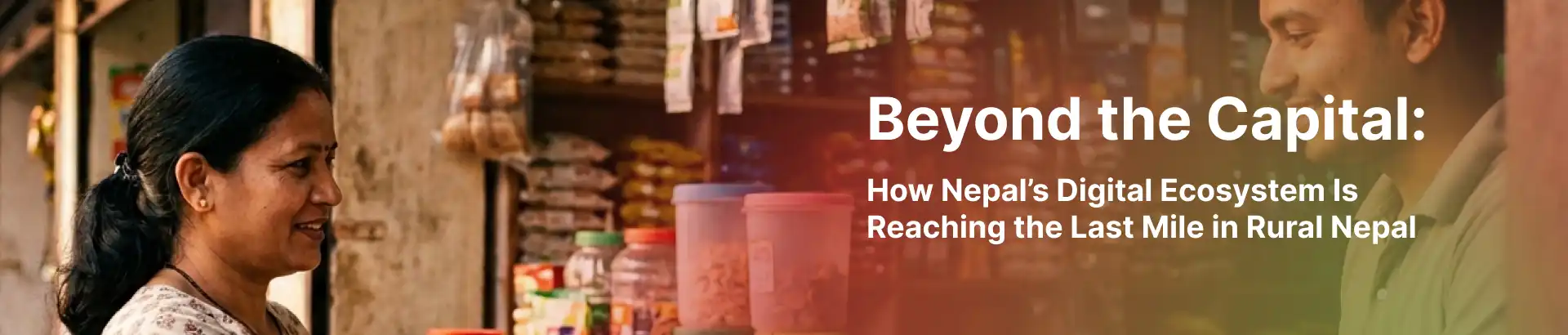
Beyond the Capital: How Nepal’s Digital Ecosystem Is Reaching the Last Mile in Rural Nepal
For decades, formal financial services in Nepal were a privilege of the urban elite. Kathmandu, Pokhara, and Dharan had the bank branches; rural communities had cash, informal lenders, and exhausting journeys through high-altitude terrain. Today, that narrative is breaking. Driven by mobile connectivity and a decentralized remittance infrastructure, Nepal’s digital ecosystem is finally reaching the "last mile." It is changing how rural households breathe.
Beyond Kathmandu: The 28 Million Opportunity
In Nepal, geography was once destiny. If you lived in a village in the Karnali region or the remote hills of Sudurpashchim, the "formal economy" was a three-day walk away. But the market has shifted. Nepal is now a remittance-dependent economy with a rapidly digitizing financial pulse. Recent data from Nepal Rastra Bank shows a 40% surge in inflows year-over-year, with totals expected to surpass Rs 2 trillion in FY 2025/26.
This isn't just about growth; it's about reach. There are roughly 28 million potential users [1] in Nepal, many of whom reside in areas where traditional bank branches will never be viable. Digital platforms aren't just an alternative; they are the only infrastructure that Scales. By January 2025, digital wallet accounts in Nepal hit 25.8 million, covering approximately 86% of the population [2]. The "center" of the economy is officially moving outward.
The 'Receiver Push' Phenomenon
The biggest misconception in global remittance is that the sender holds all the power. In the Nepal corridor, the reality is the opposite. We call this the "Receiver Push" phenomenon. In rural households, the beneficiary—the mother, the spouse, the retired father—often decides which app or service will be used.
They choose based on proximity, trust, and utility. When a beneficiary in a mountain village tells their relative in Dubai or Kuala Lumpur, "Send it via eSewa Money Transfer," the decision is final. Initiatives like "Mero Digital Desh" [3] have catalyzed this shift, offering incentives that turn a simple payout into a digital event. The beneficiary isn't just a recipient; they are the digital gatekeeper of the corridor.
Frequency vs. Volume: Why Wallets are 'Stickier'
Remittance partners often focus on the "big ticket" volume. However, the true value for the Nepali market lies in frequency. A one-off cash pickup is a transaction. A digital wallet transfer is the start of a relationship.
Digital ecosystems thrive on high-frequency, lower-volume interactions. When money reaches an eSewa wallet, it doesn't just sit there for a single withdrawal. It becomes a tool for daily life:
Mobile Top-ups: Keeping families connected across borders.
Utility Payments: Settling electricity and water bills from a mobile screen.
Data Packs: Enabling the next generation to access global education.
This creates "sticky" users. These individuals don't just use the service once a month for remittance; they engage with the ecosystem daily. For partners, this means higher lifetime value and a more resilient user base that stays within the formal economy.
Defining "Last-Mile" Reality: The Human ATM
In Nepal’s unique terrain, "last-mile" isn't a marketing buzzword. It's a functional survival tactic. Reaching the most remote doorstep requires a hybrid of high-tech and human presence:
The Agent Backbone: EMT leverages over 100,000 eSewa wallet agents and over 10,000 payout agents [4] across all 77 districts. These aren't just cashiers; they are local experts who act as human "ATMs" in villages where no bank would ever build a branch.
The Digital Nepal Vision: By integrating over 49 banks and 5,000 digital services, the ecosystem ensures that once money reaches a rural wallet, it has a reason to stay digital.
Bridging the Divide: For those in "dark zones" without smartphones, USSD-based payments ensure that feature-phone users aren't left behind [5]. Inclusion doesn't require a screen; it requires a connection.
From Payout to Progress
The true value of reaching the last mile is what happens after the money arrives. When money stays digital, it starts to work. It moves from being "spent" to being "managed." Through the EMT ecosystem, rural users move beyond being cash-out recipients. They become participants in Nepal's broader economic success.
They pay insurance premiums. They contribute to the Social Security Fund (SSF) [6]. They build a digital history that can eventually unlock formal credit. This is how money movement becomes long-term financial progress.
Metric | Traditional Cash System | Digital Ecosystem |
|---|---|---|
Accessibility | Restricted to urban bank branches | 100,000+ local agents & mobile |
Processing | Subject to branch hours/delays | Real-time, 24/7 availability |
User Engagement | Low frequency (monthly pickups) | High frequency (daily utility) |
Financial Identity | Informal, invisible footprint | Verifiable digital history |
The Road Ahead
The future of remittance in Nepal will not be defined by how much money enters the country. It will be defined by the safety, speed, and utility with which it reaches the door. By bridging this gap, digital platforms ensure that geographical isolation no longer means financial exclusion. Isolation is over. Progress is now local.
References
[1] Nepal Rastra Bank (NRB): Economic Review FY 2025/26 - Migration and Remittance Inflows Report. (nrb.org.np)
[2] Nepalytix (Jan 2025): Nepal Digital Payments Market Overview - Wallet Penetration and Adoption Rates. (nepalytix.com)
[3] eSewa Money Transfer: Mero Digital Desh Initiative - Behavioral Drivers for Formal Remittance. (esewamoneytransfer.com/mero-digital-desh)
[4] eSewa Official Ecosystem Report (2025): Agent Network and Infrastructure Coverage across 77 Districts. (esewamoneytransfer.com/agent-network)
[5] Digital Nepal Framework 2.0: Bridging the Digital Divide - USSD and Feature Phone Financial Inclusion Strategies. (mocit.gov.np)
[6] Social Security Fund (SSF) Nepal: Integration with Digital Wallets for Overseas Workers and Self-Employed Contributions. (ssf.gov.np)