
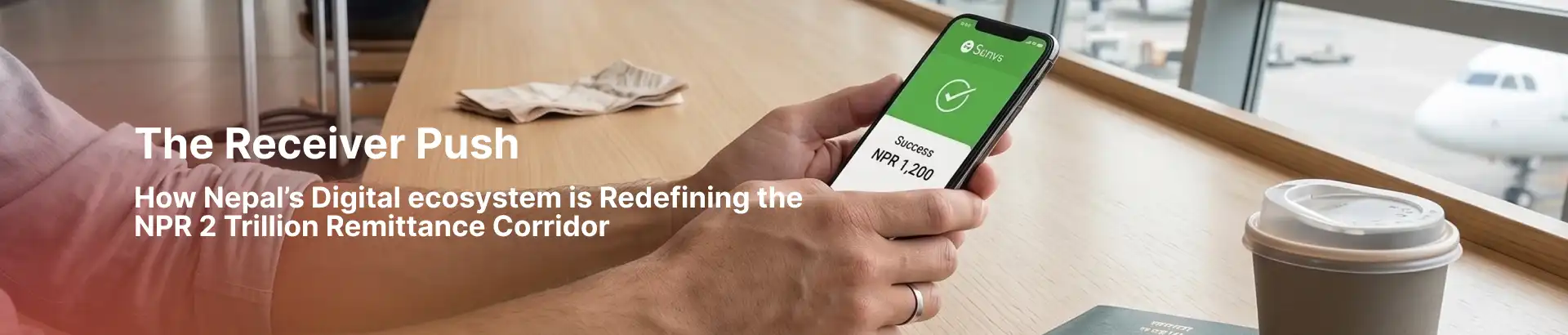
The Receiver Push: How Nepal’s Digital ecosystem is Redefining the NPR 2 Trillion Remittance Corridor
In the global landscape of cross-border finance, few corridors exhibit as much growth potential as Nepal. By the close of the 2025/26 fiscal year, Nepal’s remittance inflows are projected to surpass NPR 2 trillion (approximately $15 billion USD). This figure anchors around 26% of the national GDP.
However, for global financial institutions and remittance partners, the headline here is more about how funds flow rather than just the volume of it. We are witnessing the emergence of the "Receiver Push," where the beneficiary in Nepal - well-integrated into the eSewa ecosystem (serving 10.8M+ users as of Jan 2026) - now dictates the formalization and channel selection of the entire corridor.
Decoding the NPR 2 Trillion Opportunity
Nepal has long been a remittance-dependent economy, but the mechanics of that dependency have changed. Traditionally, remittance was a "cash-to-cash" utility. It was a slow, transactional burden where families traveled to urban centers to collect funds.
In the first eight months of FY 2025/26, Nepal Rastra Bank (NRB) data revealed NPR 1.45 trillion in inflows. This represents a 37.67% year-on-year growth. The surge occurred despite a slight decline in first-time labor permits. The trend with this data signals an underlying shift toward higher-value and more formalized digital channels.
For a remittance service provider, growth is no longer driven by the number of people moving across borders, but rather driven by the frequency and stickiness of the transactions.
How Sending and Receiving Money is Changing
For decades, remittance marketing targeted the "Sender." The logic was simple: the person with the money decides how to send it. In Nepal, that logic is failing.
The "Receiver Push" is a reversal of authority. The beneficiary in Nepal uses eSewa for every aspect of their daily life, from purchasing tea via Fonepay QR to paying school fees and insurance premiums. Consequently, they tell the sender abroad exactly which channel to use.
We must also look at the profiles of the migrants themselves. They are no longer just foreign workers. They are financial managers for their families and kin back home.
Take Naresh (30, from Khotang) and Bishal (22, from Surkhet). Currently preparing for deployment to Malaysia, these young migrants represent a new wave of expectations. "Sending money home" might be an end goal for them, but when we look at how they want to do so, they are looking for ways to stay connected to their household's progress.
Naresh already uses eSewa to manage his family's electricity and water bills from his smartphone. When he lands in Malaysia, he won't stop.
Bishal represents the micro-transactional shift. He plans to send smaller, more frequent amounts to cover his siblings' school fees via QR.
Global Footprints, Local Habits
Digital habits travel. As Nepalis move to the GCC, Europe, and Australia, they don't leave their financial routines at the airport.
Younger migrants like Ashok (19, from Kohalpur) are entering the global workforce with a digital-first mindset. For Ashok, "going to a bank" to receive money feels outdated. He prefers A2A (Account-to-Account) and wallet transfers that mirror the instant gratification of the apps he already uses in Nepal.
Alin (28, working in Australia) and Angad (25, in South Korea) provide proof of this persistent demand for connectivity.
Alin doesn't just send a lump sum. He uses remittance apps that allow more financial control for him, working with his personal eSewa account to pay for his parents' insurance in real-time.
Angad uses partner channels to ensure his loan repayments are settled instantly. He relies on the trust he built with eSewa long before he left Jumla.
For global partners, the implication is a shift in role. It is a move from acting as a simple payout point to becoming a bridge to the user’s existing financial life.
Why EMT is the Essential B2B Partner
At the center of this shift is Esewa Money Transfer (EMT). As the B2B utility layer for the ecosystem, EMT provides the infrastructure that allows global players to tap into the "Receiver Push."
With access to over 11 million users and the Fonepay network as a part of the F1Soft ecosystem, EMT offers scale and institutional stability. Our team at EMT aims to turn money movement into financial progress. Partners who leverage our A2A connectivity and API integrations offer their users more than a low fee. They offer utility.
Sticky Users: When a sender knows their funds are used for a specific purpose (school, utility, insurance), they send more frequently.
Brand Loyalty: By aligning with eSewa, partners benefit from a halo effect of reliability and local resonance.
Scaling with the Future of Nepal
The Nepal remittance corridor is no longer a static pipeline. It is an evolving, digital ecosystem. As we look toward a $20 billion corridor, the winners will be the organizations that start listening to the "Receiver" in Nepal.
The 'Receiver Push' is here. The digital habits of migrants like Naresh, Alin, and Angad are the new markers of corridor growth. At Esewa Money Transfer, we invite you to be part of this progress—delivering value that moves into the lives of every Nepali, everywhere.